
.png)
KARTET Eligibility Criteria 2025: Check Age Limit, Educational Qualification

KAR TET 2025 notification is expected to be released soon. KAR TET stands for Karnataka Teaching Eligibility Test. It is conducted by the School Education Board of Karnataka for the recruitment of both primary school teachers and upper primary school teachers in different government schools of Karnataka. The Karnataka TET Recruitment exam is conducted in two sessions for Paper 1 and Paper 2.
Karnataka TET Exam Date 2025
Based on the previous year's data regarding the exam dates of Karnataka TET 2025, candidates can have an idea of the examination schedule. Below is the table mentioning tentative Karnataka TET exam dates for 2025:
Table of Contents
- KAR TET Notification
- KAR TET Eligibility
- KAR TET Application
- KAR TET Salary & Benefits
- KAR TET Exam Pattern
- KAR TET Syllabus
- KAR TET Books
- KAR TET Admit Card
- KAR TET Answer Key
- KAR TET Result
- KAR TET Previous Cutoff
- FAQs
Karnataka TET Notification 2025
Karnataka School Education Board will released the Karnataka Teaching Eligibility Test Exam notification in the respective year of the examination. The official notification of the Karnataka TET Exam 2025 will be released on the official website. Notification conveys important information regarding the Karnataka TET exam including exam dates, exam pattern, syllabus, and exam day guidelines.
Karnataka TET Eligibility Criteria 2025
The exam conducting body has prescribed eligibility criteria for Paper 1 and Paper, which you need to fulfill in order to be eligible for the exam:
Karnataka TET Paper 1 Eligibility (Class 1-5)
- PUC/Senior Secondary (or its equivalent) with at least 50% marks and passed or appearing in the final year of a 2-year Diploma in Elementary Education (by whatever name known) (OR)
- PUC/ Senior Secondary (or its equivalent) with at least 50% marks and passed or appearing in the final year of a 4-year Bachelor of Elementary Education (B.EL.Ed) (OR)
- Senior Secondary (or its equivalent) with at least 50% marks and passed (OR)
- Appearing in the final year of a 2-year Diploma in Education (Special Education) (OR)
- Graduation with at least 50% marks and passing or appearing in the final year of 2-year Diploma in Elementary Education (by whatever name known) (OR)
- Graduation with at least 50% marks and passing or appearing in Final-year Bachelor in Education (B.Ed)
Karnataka TET Paper 2 Eligibility (Class 6-8)
- Graduation with at least 50% marks and passing or appearing in the final year of a 2-year Diploma in Elementary Education (by whatever name known) (OR)
- Graduation with at least 50% marks and passing or appearing in the final year of a 2-year Bachelor in Education (B.Ed) (OR)
- PUC/ Senior Secondary (or its equivalent) with at least 50% marks and passed or appearing in the final year of a 4-year Bachelor in Elementary Education (B.El.Ed) (OR)
- PUC/Senior Secondary (or its equivalent) with at least 50% marks and passed or appearing in the final year of 4- year B.A.Ed /B.Sc.Ed (OR)
- Graduation with at least 50% marks and passing or appearing in Final-year B.Ed. (Special Education)
Karnataka TET Relaxation in Educational Eligibility
- The conducting body will offer relaxation to a candidate up to 5% in the qualifying marks in the minimum Educational Qualification meant for eligibility shall be allowed to the candidates belonging to reserved categories, such as SC / C-I / ST or Differently abled.
- Board will consider a Diploma/Degree course in teacher education recognized by the National Council for Teacher Education (NCTE).
- The minimum qualifications referred to above, apply to the teachers of Languages, Social Studies, Mathematics, and Science only.
- if you are appearing in the final year of a Bachelor's Degree in Education or Diploma in Elementary Education etc. are provisionally admitted and their Karnataka TET Certificate shall be valid only on passing the aforesaid Examinations with prescribed marks.
Karnataka TET Amanuensis (SCRIBE)
According to the Government of India, Ministry of Social Justice and Empowerment Department of Disability guidelines vide OM F. No. 16-110/2003-DD.III dated 26.02.2013, the below-mentioned instructions are applicable regarding differently-abled candidates.
- The board will allow differently-abled candidates who are making use of scribe/amanuensis will be offered a compensatory time of 50 minutes for each paper. For candidates who are not availing of the facility of the scribe, the board will allow may also time of 50 minutes to them.
- The board will allow the facility of scribe/amanuensis to any candidate who has a disability of 40% or more if desired by the candidate.
- Board has set criteria for educational qualification, age, etc. for the scribe/ amanuensis.
- The proper seating arrangement on the ground floor should be made before the commencement of the Examination.
Karnataka TET Certificate Eligibility
- If you clear the test you will receive a certificate. You must make sure you full fill below-mentioned eligibility conditions for the certification
- If you fall under the General category /2A/2B/3A/3B should secure a minimum of 60% to be eligible.
- If you belong to a Scheduled caste / Scheduled Tribe / C-I, differently-abled you should secure a minimum of 55% to be eligible.
- If you appear for the Karnataka TET Exam and obtain the minimum qualifying marks as prescribed in the notification an Electronics Marks Statement will be issued. The board will not issue any printed hard copy of the marks sheet.
- Qualifying for the exam would not confer a right for recruitment/employment to any person as it is only one of the eligibility criteria for an appointment.
- Board will give no grace marks to any of the questions deleted. However, the results will be declared considering the total marks after deleting the questions.
Karnataka TET Overall Eligibility Criteria 2025
| Particulars | Details |
|---|---|
| Age Limit | Minumum age 18 years Maximum age 35-40 years |
| Educational Qualification | Graduation |
| Nationality | Must be a citizen of India |
| Number of Attempts | Until Crossing the Maximum Eligible Age |
| Experience | No prior experience is required. |
How to Apply Online for KAR TET 2025?
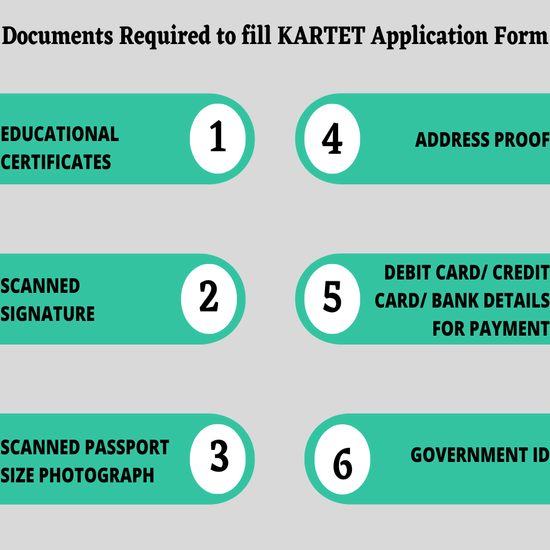
- Before applying online, it is advisable to read the intructions carefully. You will hvae to fill the online form through registration and login. You need to upload scanned image of photograph and signature (less than 40 KB). Fees payment can be done through Internet Banking/Debit Cards/Credit Cards/UPI.
- Make note that fee once submitted will not be refunded in any scenario. You will be able to download your application form by using your User Name and Password. It is advised to preserve your final online application form for any future use.
Karnataka TET 2025 Application Fee
| Category | Application Fees | |
|---|---|---|
| Paper I or II only | Paper I and II | |
| General, 2A, 2B, 3A and 3B | Rs. 700/- | Rs. 1000/- |
| SC/ST/CI only | Rs. 350/- | Rs. 500/- |
You can use the following modes of payment.
- Internet Banking (All Banks)
- Credit / Debit Card (Valid Cards are Visa, MasterCard, and Maestro Card)
- UPI (All Banks)
Here is an infographic regarding Documents required in KAR TET Application Form 2025
Karnataka TET Salary and Benefits
The salary of teachers who Karnataka TET is decent. In addition to this, they are also eligible for other benefits including house rent assistance and dearness allowance, etc. You can check out the detailed breakage of the Karnataka TET salary slip below-
| Pay Scale | INR 9,300-34,800 |
|---|---|
| Grade Pay | INR 4200 |
| Basic Salary | INR 13,500 |
| Dearness Allowance (calculated at 90%) | INR 12,150 |
| House Rent Allowance | INR 1,350 (for rural areas) |
| Gross Salary | INR 27,000 |
Karnataka TET Exam Pattern 2025
| Exam | Karnataka TET Paper 1 | Karnataka TET Paper 2 |
|---|---|---|
| Mode of Exam | Offline | Offline |
| Number of Sections | 5 | 4 |
| Name of Sections |
|
|
| Duration of the Examination | 150 minutes | 150 minutes |
| Type of Questions | Objective-based MCQs | Objective-based MCQs |
| No. of Questions | 150 | 150 |
| Maximum number of marks | 150 | 150 |
| Marking Scheme | No negative marking | The minimum qualifying mark is 40% on each paper |
| Language of Paper | English, Kannada, Urdu, Hindi, Tamil, Telugu, and Marathi. | English, Kannada, Urdu, Hindi, Tamil, Telugu, and Marathi. |
Karnataka TET Syllabus 2025
The curriculum is crucial for successful exam preparation. It is easier to focus on preparation with proper efforts in the proper direction if you have a solid comprehensive knowledge of the syllabus. You can view the most recent curriculum for the KAR TET 2025 from the table given below
| KAR TET Paper 1 Syllabus | |
|---|---|
| Child development and Pedagogy | Child Development:
|
| Language I | Language Comprehension Reading unseen passages:
|
| Language II | Language Comprehension Reading unseen passages:
|
| Mathematics |
|
| Environmental Studies | Our Environment:
|
| Social Studies | History
|
| Paper II | |
| Mathematics |
|
| Language I | Language Comprehension Reading unseen passages:
|
| Language II | Language Comprehension Reading unseen passages:
|
| Science | Physics
|
| Social Studies | History
|
Karnataka TET Preparation Books
The following books will benefit you in your preparation work and help them crack the exam. The recommended books for Karnataka TET 2025 are mentioned below.
Karnataka TET Books for English Language
The following table contains recommended books for English Language.
| English Language | |
|---|---|
| Name of the Book | Author/ Publications |
| Class I to XII Textbooks and workbooks | Karnataka Textbook Society |
| Class I to XII Textbooks and workbooks | NCERT |
| D.Ed. Methods of Teaching English I & II Year | DSERT Karnataka |
| B.Ed. Methods of Teaching English I & II Year | University Prescribed Syllabus |
| Approaches and methods in Language Teaching | Jack C. Richard and Theodore S Rodgers |
| Dictionary & Thesaurus | Cambridge/Oxford |
| English Grammer & Composition-Primary- | P.C Wren and H Martin |
| Essential English Grammer | Raymond Murphy |
| English Grammer & Composition-High School | P.C Wren and H Martin |
| Common skills in English | IGNOU BEGE- 103 |
Karnataka TET Books for Urdu Language
The following table contains recommended books for Urdu Language.
| URDU Language | |
|---|---|
| Name of the book | Author/Publication |
| 1 st Standard to 10th Standard First Language Urdu Text Books NIDA-E-URDU AND NAU BAHAR-E-ADAB | KTBS Bangalore |
| First Language Urdu Resource Book For D.Ed- First Year & Second Year BARAYE - D.Ed Sal Awal Aur Duam. | |
| Urdu Dictionaries | |
| Learning Material With Respect To B.EdSyllabus (Semester 2&3). Supporting Material FromUsmania University Moulana Azad Open University. | |
Karnataka TET Books for Tamil Language
The following table contains recommended books for Tamil Language.
| Tamil Language | |
|---|---|
| Name of the Book | Author/Publications |
| 1st Standard -10th standard text books1st Language Tamil | KTBS Bangalore |
| Natramizh Karpikkum Moraigal | V GanapathiSantha publications |
| Tamil Sudar- Content Enrichment and Methodology | DSERT |
| Vetri Katturaigal- Tamil | |
| Tamil Losai - Tamilnadu Text Book 5th to 9th Standard Textbook | |
| 8th Standard Tamil Thenaruvi- Tamil 1 st Language Tamil | KTBS Bangalore (2010) |
| Uyarnilai Palliyia Tamil Karpitha Asiriyar Kaiyedu | P Veerappan NCERT- Mysore |
| Paintamil Karpikum Murai | V Ganapathy |
Karnataka TET Books for Telugu Language
The following table contains recommended books for Telugu Language.
| Name of the Book | Author/ Publication |
|---|---|
| 1 st Standard -10th standard textbooks | KTBS Bangalore |
| D.Ed Telugu Bodhana Paddathulu |
|
| B.Ed Telugu Bodhana Abhyasana Shastram |
|
Karnataka TET Books for Marathi Language
The following table contains recommended books for Marathi Language.
| Marathi Language | |
|---|---|
| Name of the Book | Author/ Publications |
| Maya Marathi Text Books 6th Standard to 10th Standard | KTBS Bangalore |
| Sugama Marathi Vyakarana VaLekhanShabdaratna | M.R. Walambe |
| Marathi Vyaakaran | Shripad Bhagavat |
| Navneet Sulabh Marathi VyakaranVaLekhan | Padmini Bineewale |
| Paripurna Marathi Vyakarana | Balasaheb Shinde |
| SampurnaBalamanashastra and Adhyapanshastra | Dr. Shashikant Annadate& Swati Shete |
| Maargadarshika | Maharashtra Rajya Pariksha Parishad Pune |
| Kavya Sangrah 1. Vishakha, PravasiPakshi 2. Horpal 3. AyushachiMalani |
|
Karnataka TET Books for Hindi Language
The following table contains recommended books for Hindi Language.
| Hindi Language | |
|---|---|
| Name of the Book | Author/Publications |
| 1st Standard -10th standard text books | KTBS Bangalore |
| Adhunik Hindi Vyakaran and Rachana | Dr. Vasudevanandaprasad |
| Bhasha Shikshana Siddhanta & pravidhi | Manoram Gupta |
| Shiksha Me Kriyaatmak Anusandhaan | K.P. Pandey |
| Saphala Shikshana Kala | PD Pathak and Tyagi |
| Shiksha Manoovignaan | Dr. Madhu |
| Hindi Vyaakaran | Kamat Prasad Guru |
| AnuvaadVignaan | Bholanath Tiwari |
| Hindi Shikshana | Dr. Ramashukla Pandey |
| ShikshaaManoovignaan | Bhai Yogindrajeet |
| Nootan Hindi Shikshan | P.D. Parak |
Karnataka TET Books for Education Psychology
The following table contains recommended books for Education Psychology.
| Educational Psychology | |
|---|---|
| Name of the Book | Author/ Publication |
| Essentials of Educational Psychology | Dr. S.K Mangal |
| NCERT, Psychology books for classes 11 and 12 | NCERT |
| Psychology of Teaching and Learning | Dr. S.K Mangal |
| Learning, Teaching, and Assessment | C B Saraswathi |
| Elements of Social Psychology | B Kuppuswamy |
| Psychology in Education | Sidney L Pressey & Francis P Robinson & John E Horrocks |
Karnataka TET Books for Science and Mathematics
The following table contains recommended books for Science and Mathematics.
| Science and Mathematics | |
|---|---|
| Name of the Book | Author/ Publication |
| Class 1 to 12 Science and Mathematics Textbooks and Workbooks of State & NCERT Curriculum | |
| D.Ed and B.Ed Course Material | |
| ICSE Concise Mathematics Class VIII- Class X | |
| CBSE Science Textbooks- (VII-XII) IGCSE | |
| CBSE Science Textbooks- (VII-XII) IGCSE | |
| Mathematics (Class IX-& Class X) | R.D Sharma |
| Mathematics (Class IX-& Class X) | A.S Agarawal |
| National Curriculum Framework for School Education-2005 | NCERT, New Delhi |
| A Text on Teaching Mathematics | Mangal S.K- Prakash Brothers Educational Publishers |
| National Curriculum Framework for School Education – NCERT New Delhi: NCERT-2005 | |
| Skills and Strategies of Teaching Mathematics | Anice James- Neelkamal |
| Content Based Methodology of teaching Mathematics D.Ed 2nd Year | Vijayalakshmi Prakashana |
Karnataka TET Books for Social Science
The following table contains recommended books for Social Science.
| Social Science | |
|---|---|
| Name of the Book | Author/Publication |
| 1 st Standard -10th standard textbooks | KTBS Bangalore |
| Methods Of Teaching | M.C Murthy |
| D.Ed And B.Ed Course Material | |
| The Teaching Of Social Studies | Tandon Publications – Ludiana –by H.Sidhu Bhatia &Navang |
| A Hand book for History Teachers | R.V. Vajreshwari 2nd edition Allied Publications Private Limited |
| Content base Methedology of Teaching Social Science | Prof. Hemalatha D & Smt. AmbaraniH.P |
| Elements of Social Psychology | B Kuppuswamy |
Karnataka TET Admit Card 2025
KAR TET Admit card will be available at least 2 weeks prior to the exam. You will be able to download the admit card from the official website once it releases. You need to carry your Admit card along with Identity proof and passport-size photo to the exam venue. The details mentioned on your admit card are as follows:
- Your name
- Exam's name and date
- the latest photograph
- Gender (Male/Female)
- Name of either the parent
- Roll Number
- Exam Time
- Time allotted for the exam
- Center for Examination and address
- Date of Birth
- Online Registration Number
- Important Examination Instructions
- Candidate and exam proctor signatures
Karnataka TET Answer Key 2025
The Karnataka School Education Board (KSEB) releases the Karnataka TET Answer Key. All of the solutions to the questions that were asked during the exam are included in the Karnataka TET answer key. It will be made available on the website, which is listed on this page, as their official website. About one month following the test, it will be released.
The Karnataka TET Answer Key 2025 will be published in this format.
Upon the publication of the formal announcement, we will update this section. After the publication of the answer key, you may appeal to a question's incorrect response.
Karnataka TET Result 2025
Karnataka TET Result 2025 will be published soon after the release of the Karnataka TET answer key 2025. It will be posted on the recruiting commission's official website.
Karnataka TET Previous Year Cut-off Marks
You need to achieve minimum cut-off marks to pass the Karnataka TET Exam. The cut-off list is prepared category-Wise. Passing the exam requires candidates to get a minimum cutoff score. Till then, you can check the cut-off list for 2016 from in the table below:
| Category | Cut-Off Marks |
|---|---|
| General/Unreserved | 115 |
| BC | 85 |
| SC | 60 |
| ST | 51 |
| OBC | 10 |
Karnataka TET 2025: FAQs
Ques. Can a higher secondary pass sit for the Karnataka TET 2025 Exam?
Ans. Yes, a higher secondary pass out can sit for the Karnataka TET 2025 Exam. There are some other education eligibility criteria as well. Check the eligibility section of this article.
Ques. How many attempts are allowed for Karnataka TET Exam?
Ans. There is no restriction on the number of attempts that a candidate can make for the Karnataka TET exam. The age limit is set by the recruiting board. A candidate who meets all other factors of the eligibility criteria can attempt it as many times as they want to, within the given maximum age limit.
Ques. Is there a negative marking in the Karnataka TET exam?
Ans: No, there is no negative marking in the Karnataka TET exam. Both papers, Paper I and Paper II do not have any negative markings.
Ques: What language will be used to conduct the Karnataka TET 2025?
Ans: Karnataka TET Exam will be conducted in several languages like English, Kannada, Urdu, Hindi, Tamil, Telugu, and Marathi except for the language sections. Candidates must choose in which language they want to take the test. The use of mixed languages will result in a score of 0.
Ques. What is the required percentage of marks to pass the Karnataka TET Exam?
Ans. The minimum cut-off marks vary every year. The monomum qualifying marks of a candidate varies on the basis of the category of the candidate. The minimum qualifying marks for the General or Unreserved category is 60%. However, the minimum qualifying marks for the OBC/SC/ST candidates is 55%.
Ques. Is Karnataka TET compulsory to be a teacher in Karnatka?
Ans. Yes, candidates must qualify the Karnataka TET exam to be a teacher in Karnataka. In Karnataka, there are many degrees of qualification for the position of teacher. Teachers of Classes 1 to 5 are known as Primary Teachers, teachers of Classes 6 to 8 are known as Upper Primary Teachers.
Ques. How long is the Karnataka TET Certificate valid?
Ans. The KAR TET Certificate's validity has lately been extended to indefinitely. The National Council for Teacher Education recently validated the Teacher's Eligibility Test (TET) certificate's lifelong validity. The TET certificate had previously been valid for seven years. While TET is required for teaching positions in government schools, it is not as crucial in private school appointments.
Ques. What is the offiical webiste of Karnataka TET Exam?
Ans. The official website of Karnataka TET Exam is https://schooleducation.kar.nic.in/. Any offiical notiifcation or latest updates regarding the Karnataka TET Exam is notified through the offiicla webiste. No letter or post are sent to the applicants. So you need to keep a check on the official website.
Ques: Is there a provisions of correction after submission of the application form?
Ans. Any correction in the information provided by the candidates in the online application should be done before paying the examination fee. No amendment /change will be allowed thereafter. In case of any discrepancy in candidate’s information after submission of application Candidates are responsible for the consequences thereof.
Ques. Can a higher secondary pass sit for the Karnataka TET 2025 Exam?
Ans. Yes, a higher secondary pass out can sit for the Karnataka TET 2025 Exam. There are some other education eligibility criteria as well. Check the eligibility section of this article.
Ques. How many attempts are allowed for Karnataka TET Exam?
Ans. There is no restriction on the number of attempts that a candidate can make for the Karnataka TET exam. The age limit is set by the recruiting board. A candidate who meets all other factors of the eligibility criteria can attempt it as many times as they want to, within the given maximum age limit.
Ques. Is there a negative marking in the Karnataka TET exam?
Ans: No, there is no negative marking in the Karnataka TET exam. Both papers, Paper I and Paper II do not have any negative markings.
Ques: What language will be used to conduct the Karnataka TET 2025?
Ans: Karnataka TET Exam will be conducted in several languages like English, Kannada, Urdu, Hindi, Tamil, Telugu, and Marathi except for the language sections. Candidates must choose in which language they want to take the test. The use of mixed languages will result in a score of 0.
Ques. What is the required percentage of marks to pass the Karnataka TET Exam?
Ans. The minimum cut-off marks vary every year. The monomum qualifying marks of a candidate varies on the basis of the category of the candidate. The minimum qualifying marks for the General or Unreserved category is 60%. However, the minimum qualifying marks for the OBC/SC/ST candidates is 55%.
Ques. Is Karnataka TET compulsory to be a teacher in Karnatka?
Ans. Yes, candidates must qualify the Karnataka TET exam to be a teacher in Karnataka. In Karnataka, there are many degrees of qualification for the position of teacher. Teachers of Classes 1 to 5 are known as Primary Teachers, teachers of Classes 6 to 8 are known as Upper Primary Teachers.
Ques. How long is the Karnataka TET Certificate valid?
Ans. The KAR TET Certificate's validity has lately been extended to indefinitely. The National Council for Teacher Education recently validated the Teacher's Eligibility Test (TET) certificate's lifelong validity. The TET certificate had previously been valid for seven years. While TET is required for teaching positions in government schools, it is not as crucial in private school appointments.
Ques. What is the offiical webiste of Karnataka TET Exam?
Ans. The official website of Karnataka TET Exam is https://schooleducation.kar.nic.in/. Any offiical notiifcation or latest updates regarding the Karnataka TET Exam is notified through the offiicla webiste. No letter or post are sent to the applicants. So you need to keep a check on the official website.
Ques: Is there a provisions of correction after submission of the application form?
Ans. Any correction in the information provided by the candidates in the online application should be done before paying the examination fee. No amendment /change will be allowed thereafter. In case of any discrepancy in candidate’s information after submission of application Candidates are responsible for the consequences thereof.